Instrumentation scope
The instrumentation scope is a logical unit of software with which emitted telemetry is associated. It can represent a module, package, class, library, or framework — any meaningful boundary that a developer chooses to distinguish one source of telemetry from another.
How a scope is defined
A scope is identified by a (name, version, schema_url, attributes) tuple,
where version, schema_url, and attributes are optional. The name should
uniquely identify the logical unit of software — for example, the fully
qualified name of a library, class, or module.
You specify the scope when obtaining a tracer, meter, or logger from a provider. Every span, metric, and log record produced by that instance is then tagged with the scope:
- For libraries and frameworks: use the library’s fully qualified name and version as the scope. If you are writing an instrumentation library for a library that has no built-in OpenTelemetry support, use the name and version of the instrumentation library itself.
- For application code: a common choice is the class or module name, such as
CheckoutService.
Why scopes matter
In your observability backend, you can filter, group, and compare telemetry by scope. This makes it possible to identify which library version is causing latency, isolate signals from a specific module, or compare behavior across versions of the same component.
Scopes in a trace
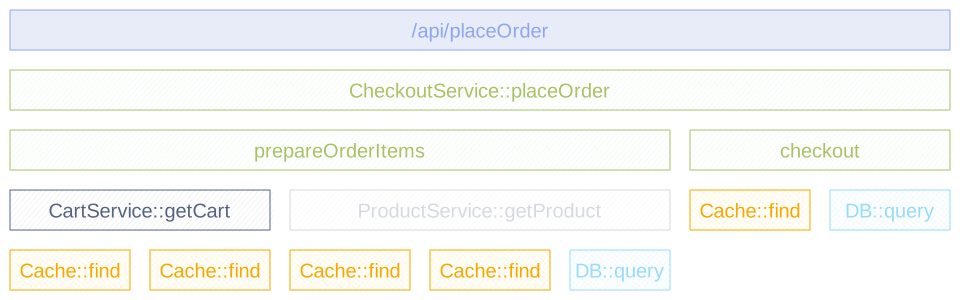
The following diagram shows a trace with spans from six different instrumentation scopes, color-coded and identified in the legend:
- The
http-frameworkscope produces the root/api/placeOrderspan. - The
CheckoutServicescope producesCheckoutService::placeOrder,CheckoutService::prepareOrderItems, andCheckoutService::checkout. All three spans share the same instrumentation scope because they are created by the same tracer instance, obtained with the nameCheckoutService. - The
CartServiceandProductServicescopes each produce a span from their respective application components. - The
Cache libraryandDB libraryscopes produce spans from library code, grouped by library name and version.
Feedback
Was this page helpful?
Thank you. Your feedback is appreciated!
Please let us know how we can improve this page. Your feedback is appreciated!