Beyond the good first issue - How to make your contributions sustainable
OpenTelemetry provides the tools and standards to collect metrics, logs, and traces from applications and services. Getting started with contributions can feel overwhelming, so here are some lessons from hands-on experience.
Most guides explain how to find a “good first issue,” fork a repository, or join a SIG meeting. That advice is useful, and many resources cover it well. What often receives less attention is the broader context around contributing: understanding the ecosystem, navigating community dynamics, and building long-term engagement in a large open source project.
These aspects are especially important in OpenTelemetry, where development happens across many repositories, SIGs, and organizations. For newcomers, and particularly contributors from underrepresented backgrounds, this context can make a meaningful difference. When the unwritten rules of collaboration and decision-making are not visible, it’s harder to know where to start, participate confidently, or grow from occasional contributor to long-term member.
This guide focuses on that deeper layer: going beyond the “first contribution” checklist to help you understand how the OpenTelemetry community works and find your place within it.
Context and community
Before diving into a specific repository, explore the broader cloud native ecosystem. What observability tools are evolving? Where are the gaps? Which projects influence OpenTelemetry adoption? Strategic contribution starts with context. Platforms like CLOTributor help you discover “good first issues” across cloud native projects, not just within one organization. This allows you to position yourself where your skills are most impactful.
Be aware that “good first issues” are highly competitive and often get claimed within hours of being posted. If you can’t find one, shift your strategy: instead of waiting for the perfect issue, become an active part of the community through SIG calls and Slack discussions, and look for ad hoc tasks where you can make yourself useful.
Initiatives like Merge Forward support underrepresented groups in open source, providing mentorship, visibility, and access that many engineers lack in traditional corporate environments. OpenTelemetry exists within this larger CNCF ecosystem that actively works to lower participation barriers.
OpenTelemetry actively supports inclusive participation through mentorship programs, localization groups, and asynchronous collaboration, helping contributors from diverse backgrounds engage on equal footing.
Contribution becomes more meaningful when you understand how projects and communities connect.
Contribution is more than code
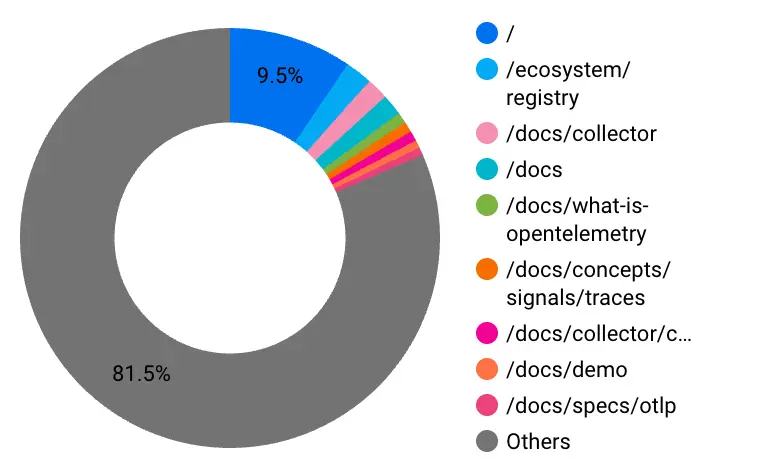
Graph showing the most popular pages from the OpenTelemetry.io website starting with January 2026 up to March 2026
A pull request is not just a code change. It is discussion, feedback and alignment with project direction. Maintainers, approvers, and SIG members guide priorities. Reading issue threads and PR discussions teaches you how decisions are made and where real friction exists. That awareness makes your contributions stronger.
For engineers from underrepresented groups in tech, visibility and sustained participation matter. OpenTelemetry provides several ways to participate that do not depend on being in a specific location or working in a large technology company. Conversations happen across multiple community spaces, including Slack channels, SIG meetings, GitHub issues, and pull request discussions. These channels allow contributors from different geographies, professional backgrounds, and experience levels to engage with the project and share practical feedback.
Participation in a global open source community is not always easy. Time zone differences mean that not everyone can attend SIG meetings live. Because of this, many technical discussions and decisions also happen asynchronously through GitHub issues, pull request reviews, and Slack threads. This allows contributors to participate when their schedules allow, even if they cannot join synchronous meetings.
Language can also be a barrier in international communities. Many OpenTelemetry contributors are non-native English speakers, and improving documentation clarity is an important part of the project. Contributors can help by simplifying complex phrasing, suggesting clearer explanations, or translating documentation into other languages. These contributions make the project more approachable for developers who are learning OpenTelemetry in different regions of the world.
Localization groups are another way the community expands participation. Translating documentation, improving examples, and adapting explanations for different language communities helps observability knowledge reach developers who might otherwise struggle to access it. Localization efforts also create opportunities for contributors who may not feel comfortable starting with code contributions.
These mechanisms are not perfect. Time zone differences, language barriers, and accessibility challenges still exist. But by supporting both synchronous and asynchronous collaboration, documentation improvements, and localization initiatives, the OpenTelemetry community provides multiple ways for contributors from diverse backgrounds to participate and help shape the future of observability tooling.
Non-code contributions go beyond documentation and blogs. You can volunteer for note-taking in SIG meetings, help organise community events like the OpenTelemetry Community Day at KubeCon, or join the Contributor Experience SIG, which focuses on making the project better for all contributors. Some examples of these SIGs are: otel-sig-end-user, otel-devex, opentelemetry-new-contributors, otel-contributor-experience, otel-docs-localization. Your contribution track is also fluid, i.e., starting with documentation does not lock you in; you can switch to code contributions as you learn more, or vice versa. All contributions count and are welcome.
If you do not see people like you in the room, that is not a signal to withdraw. It is an opportunity to participate.
Tips for beginners
Start small. Documentation improvements, examples, test fixes, localization, and developer experience feedback are valuable. The codebase evolves quickly, and things change often. Do not be discouraged by that.
Your background is leverage. If you are an SRE, platform engineer, backend developer, or DevRel professional, you understand production realities. You know where documentation feels unclear and where automation breaks. That insight is practical and needed. Community context matters as much as technical skill.
Background also goes beyond technical roles. Non-native English speakers can spot unclear phrasing, uncommon words, or ambiguous explanations and help simplify or localize them. Contributors with accessibility needs often identify gaps in documentation, tooling, or processes, improving readability, navigation, and inclusivity.
These contributions, often overlooked, are just as critical as writing code. They shape the experience for everyone in the community. In large open source communities, these perspectives matter as much as technical skill. Improving clarity, accessibility, and usability strengthens the ecosystem and enables broader participation.
Let’s talk about a pain point that’s very common across most of CNCF’s Slack channels. Not being able to get feedback or PR reviews. If you do not get reviews right away, be patient. Most maintainers have a day job in addition to maintaining the project, so delays are normal. You can always post a message in the corresponding Slack channel with enough context so that anyone can pick up the review. Use this time to review any other open PRs yourself and gain a broader understanding of the codebase.
Who to talk to
Engage with maintainers, SIG members, senior contributors and approvers. They shape direction and review work. Observing their discussions accelerates learning.
The End User SIG actively seeks practitioner feedback. Contributing through interviews and discussions can influence the project beyond code. For many contributors, especially those outside dominant tech hubs, these channels create visibility and meaningful participation. Trust grows through consistency.
Understand the pieces
OpenTelemetry includes SDKs in multiple languages, the Collector, instrumentation libraries, and protocols such as OTLP, gRPC, and HTTP. Understanding how these components interact gives you perspective.
Emerging initiatives like OTel Injector and OTel Weaver focus on automation and simplifying telemetry configuration. Contributing to newer efforts can be impactful because you influence adoption patterns early. Another domain is language SDKs for PHP, Ruby, Erlang, and Rust, which often have only a couple of maintainers and could use extra hands. The eBPF auto-instrumentation project (OBI) is a newer frontier that allows capturing telemetry data at the kernel level without modifying application code. If you are interested in low-level programming or Linux kernel tech, this is a great place to contribute.
Thinking beyond a single repository strengthens your contribution strategy.
Official documentation: A starting point
The official documentation provides the foundation. Contributing to clarity, examples, and localization improves accessibility and adoption. Some specific areas are currently under-resourced and could use more contributors.
Documentation localisation is a major need; some language communities, like Japanese and Chinese, have been very active in translating OpenTelemetry docs, but others have barely started. If you are fluent in any language besides English, you can make a big difference by contributing to localisation efforts. When documentation exists in more languages and reflects real-world use cases, it expands who can participate.
Setting up a local sandbox
Hands-on exploration builds confidence. Clone repositories, run tests, modify instrumentation, and experiment with telemetry pipelines. Practical experimentation complements community engagement.
Expanding your knowledge
Structured learning deepens understanding. CNCF learning resources and courses offer curated materials that guide learners through these concepts step by step. In addition, the Linux Foundation OpenTelemetry Certification provides a practical way to validate your knowledge while reinforcing core ideas about telemetry pipelines, instrumentation strategies, and observability architecture across the ecosystem. Learning, contributing, and teaching reinforce each other.
Making contributions sustainable — an example
Starting is simple. Staying engaged is what creates impact.
Sustainable contribution means choosing a focus area, attending SIG meetings, reviewing work, mentoring newcomers, and sharing knowledge. It is about consistency, not one large code change. Many contributors drop off after a couple of contributions. Aligning your contributions with what excites you helps build a realistic routine: weekly or monthly contributions, attending SIG meetings (even as a listener), tracking GitHub updates, and staying active in Slack. Curiosity and learning drive consistent engagement.
Long-term consistency builds credibility and influence, especially for underrepresented contributors, where visibility matters.
OpenTelemetry offers a visible and structured pathway for growth. For engineers from underrepresented groups, this matters. It provides credibility, influence, and community recognition beyond traditional corporate hierarchies.
You do not need to be perfect. You need to participate. Be curious. Think ecosystem. Use tools like CLOTributor to explore opportunities. Connect with initiatives like Merge Forward if you need support. Diversify how you contribute and stay consistent.
The ROI of contributing can also be significant, both personally and professionally. You will gain a deeper understanding of how instrumentation, tracing, and metrics work under the hood. You will interact with engineers from companies across the industry, and these connections can lead to job opportunities and collaborations. Many contributors also find fulfillment in paying it forward to the open source community that has benefited them.
OpenTelemetry is a global collaboration. There is space in it for you.